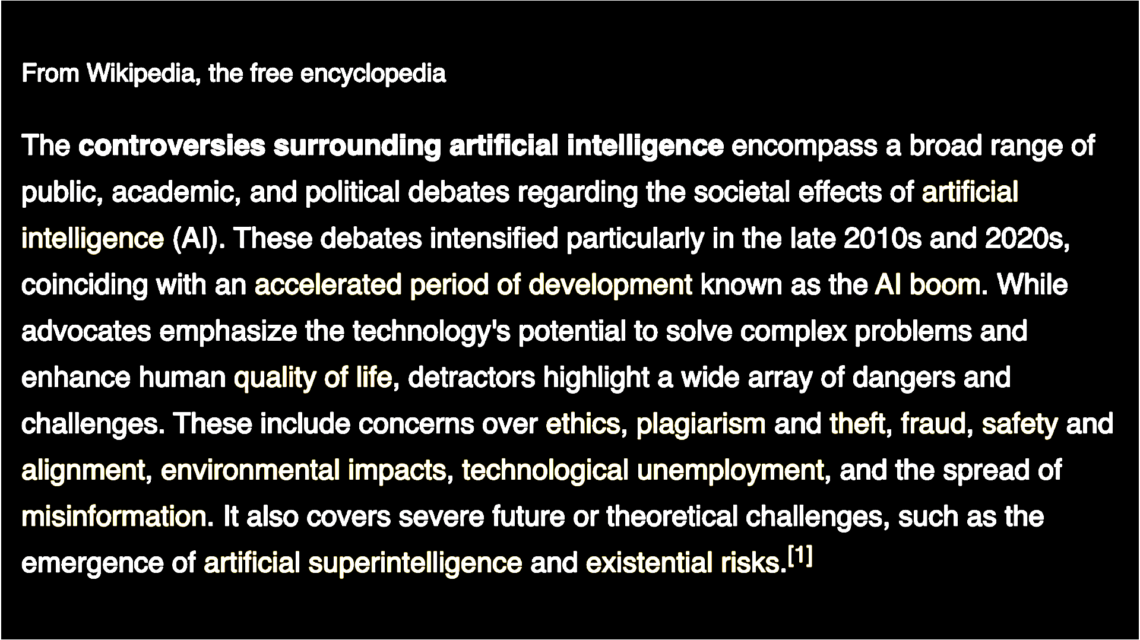
Using AI to make art, music or writing can be very fun, and feel creative—I have some AI art on this website—but indiscriminate AI use can be problematic for creatives in particular—and the world in general. I’ve stopped doing it entirely and I hope you do too. (See this Wikipedia article for an extensive exploration of the topic.) Here’s why I stopped:
- Using AI for artwork removes human creativity from the process entirely—thinking up prompts is not the same as actually using experience and talent to create original art.
- This greatly reduces the ability of creatives of all types to make a living—photographers, animators, illustrators, designers, writers, musicians and many more. For instance, there is less and less work for designers like me, as Canva and other platforms take over.
- There’s evidence that using AI to make art doesn’t use the “creating” part of the brain the way creating artwork from scratch does. (I’m still looking for definitive studies on this and will link to them when I find them.)
- AI doesn’t actually create artwork; it plagiarizes existing artwork of actual humans. For instance, you can ask an AI platform to make art “in the style of [X person]” and it will steal their existing work as templates and source material.
- AI computing power can be very helpful in medicine and the sciences, e.g., to crunch a lot of data that would take humans an impractically long time (minutes or seconds instead of hours, days, or longer). Humans are still necessary, however, to make experience- and intuition-based judgment calls on that data output. One example is reading radiology findings: in some cases, AI is more accurate, but a specific finding may remind a human of another uncommon thing in their particular experience, thereby making a new diagnosis or possibly saving a life.
- Practically, AI uses huge amounts of computing power, requiring large data centers:
- Large data centers consume inordinate amounts of electricity and water (for cooling).
- Large data centers are generally built in poor areas, creating a drag on local resources but not providing new jobs for the people there.
- The increase in the number of data centers raises electricity and water costs across the country.
- An extremely somber—and sinister—use of AI is in war, especially if that use is inadequately supervised by humans. An exhaustively researched article in the reputable UK news outlet The Guardian, titled “AI got the blame for the Iran school bombing. The truth is far more worrying,” gives an analysis of the role of technology, in general, and AI in particular, in military decision-making throughout history.
- In modern military parlance, says the article, the ‘“kill chain”…refers to the bureaucratic framework for organising [sic] the steps between detecting something and destroying it.’ The article concludes that if combatant states or entities rely exclusively on technology to carry out kill chains, crucial human knowledge that might slow and refine the pace of them is omitted. For instance, the tragedy of the US strike on an Iranian girls’ school in a former military facility might have been avoided if better human intelligence had been used.
- Of course, the entire US/Israel war on Iran itself is utterly unnecessary and increasingly tragic. Don’t get me started.
- One of the most important detractions of AI, again, is the propensity of its use to replace human jobs. This has a devastating effect on individual and collective people’s lives: if this trend continues, more and more people will simply be out of work, therefore weakening economies in general. In the end, the people that AI helps most are those who have connections to the business of AI: people who have stock in AI companies, for example.