From https://en.wikipedia.org/wiki/Winter_solstice:
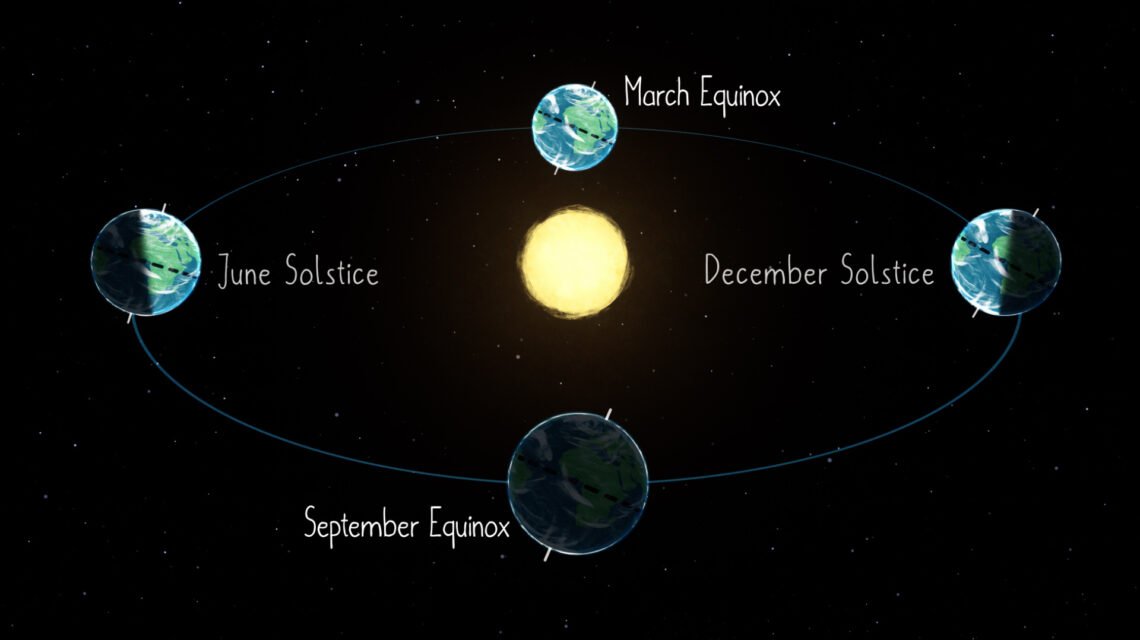
The winter solstice, or hibernal solstice, occurs when either of Earth‘s poles reaches its maximum tilt away from the Sun. This happens twice yearly, once in each hemisphere (Northern and Southern). For that hemisphere, the winter solstice is the day with the shortest period of daylight and longest night of the year, and when the Sun is at its lowest arc in the sky.[1] In each polar region, there is continuous darkness or twilight around its winter solstice. The opposite event is the summer solstice, which happens at the same time in the opposite hemisphere.
The winter solstice occurs during the hemisphere’s winter. In the Northern Hemisphere, this is the December solstice (December 21 or 22) and in the Southern Hemisphere, this is the June solstice (June 20 or 21). Although the winter solstice itself lasts only a moment, the term also refers to the day on which it occurs. Traditionally, in many temperate regions, the winter solstice is seen as the middle of winter, and “midwinter” is another name for the winter solstice, although it carries other meanings as well. Other names are the “extreme of winter”, the “shortest day” and the “longest night”.
Since prehistory, the winter solstice has been a significant time of year in many cultures and has been marked by festivals and rites.[2] This is because it is the point when the shortening of daylight hours is reversed and the daytime begins to lengthen again. In parts of Europe it was seen as the symbolic death and rebirth of the Sun. Some ancient monuments such as Newgrange, Stonehenge, and Cahokia Woodhenge are aligned with the sunrise or sunset on the winter solstice.